Early Access
Brasara™ Polyphonic Synthesizer
8-Voice, Two-Channel Polysynth for VST®3, Audio Unit and AAX (Pro Tools), and a Standalone app
A closer look
Brasara's Arp & Seq page: channel I's arpeggiator playing a rising pattern, and channel II's chord sequencer with sixteen steps of chords on small piano rolls, each with velocity and pressure bars.
About Brasara™ Polyphonic Synthesizer
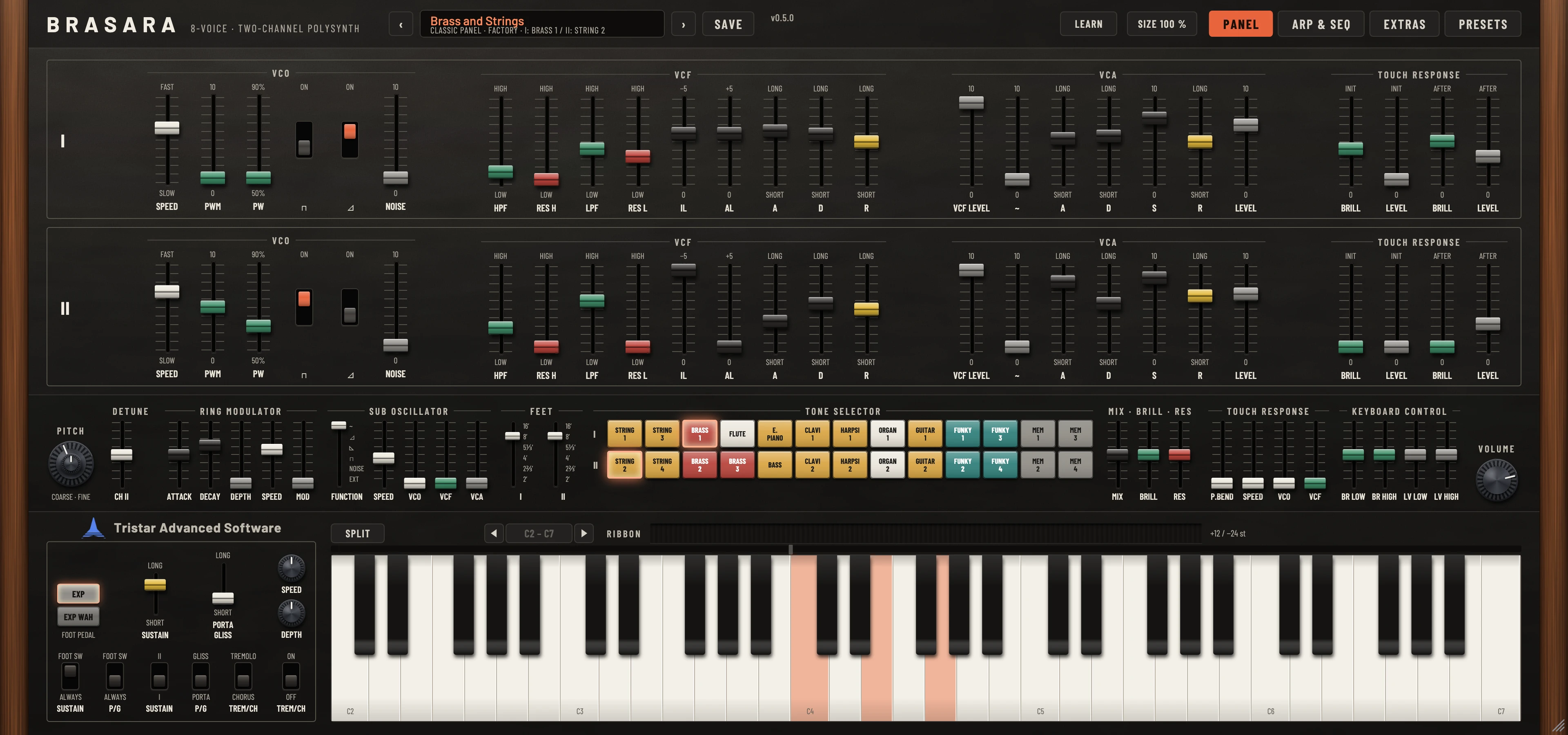
Brasara™ is a big, expressive polyphonic synthesizer in the grand style of a particular late 1970s classic: every voice is two complete synthesizer channels, played from a full-size panel of sliders and levers, with a ribbon for pitch bends and per-note pressure on every key. Around that classic heart sit the things the old instruments never had: a key split, an arpeggiator on each channel, a 64-step chord sequencer, voice character, studio effects and a preset browser with favorites and ratings. Use it in your DAW as a VST3, Audio Unit (AU) or AAX instrument, or play it on its own with the included standalone app. No DAW required.
Sound
Two channels in every voiceEach voice has two identical synthesizer channels, I and II, each with its own oscillator (sawtooth, pulse with its own PWM, a sine and noise), a high-pass and a low-pass filter with resonance, a filter envelope that can start below and rise above the cutoff, and its own amplifier envelope. Layer them, detune channel II, set either one from sixteen feet up to two feet, and balance them with MIX. The resonance has the classic instruments' edge, and an extended setting takes it much further, until the filters ring hard.
Layer them, or split the keysPlay both channels on every key, as the classics did, or split the keybed between them: channel I to the left, channel II to the right, at any key you choose on the rail above the keys. A bass under a lead, pad chords under a solo, an arpeggio in the left hand: each side keeps its own arpeggiator, and the split is saved with each preset.
The tone selectorTwo rows of lit buttons, one per channel, call up 22 classic voicings: strings, brass, flute, electric piano, bass, clavi, harpsichord, organ, guitar and funky sounds. Press one and that channel's sliders move to it, ready to play or tweak, while the other channel keeps its own sound. Four MEM buttons become hot-keys for your own presets: hold one for two seconds to link it.
Touch and expressionVelocity and per-note pressure each reach brightness and level separately on each channel, so a chord can open up under one finger. Notes can slide up into pitch as you strike them, and pressure can add vibrato and wah. The ribbon bends the pitch from wherever you touch it, an octave up and two down at first (up to two up and four down), and springs back when you let go; as on the classics, the sustain switch decides whether it bends notes ringing on after you let go.
MPE and MIDI LearnPlay Brasara from an MPE controller and every note bends, swells and changes its tone on its own: per-note pitch, pressure, and slide to brilliance, level or vibrato. And with MIDI Learn, any knob or slider on your controller can take over any control: click LEARN, click a control, move a knob. The mod wheel goes where each sound sends it: vibrato, growl, tremolo, brightness or the channel LFOs.
The classic common sectionA sub oscillator for vibrato, trill, wah and tremolo; a ring modulator with its own attack and decay; keyboard scaling of brightness and level; sustain and portamento or glissando on the foot switch; an expression pedal for volume or wah; and a stereo tremolo and chorus.
Eight voices, or sixteenPlay eight voices as the classics did, or sixteen. Switch to Mono, or to Unison with up to eight stacked voices, detuned and spread across the stereo field. Voice Character gives each voice its own small tolerances in tuning, cutoff, envelope times and pulse width, with a slow drift, and every unit setting gives a different instrument. Optional 2x oversampling smooths the top end when your computer has power to spare; off, Brasara uses about half the processing.
Movement
An arpeggiator on each channel, with Up, Down, Up/Down, Order, Random and Chord modes over up to four octaves, swing, latch and sync to your DAW. Pressure from the keys you hold follows the notes they play.
A 64-step chord sequencer that plays on channel I, channel II or both: up to five notes per step, each step with its own velocity and its own pressure. Record chords from the keyboard or edit each step on its piano roll, and transpose the sequence live from the keys.
Run an arpeggio on one channel against the sequence on the other.
A second LFO on each channel, with five waveforms, tempo sync and a fade-in delay, to the channel's pitch, pulse width, cutoff or level.
Effects
After the tremolo and chorus come two effect slots, each any of twelve types: stereo, BBD and tape delays (tempo-synced), chorus, flanger, phaser, high-pass filter, distortion, ring modulator, rotating speaker and lo-fi. These are followed by a lush plate reverb.
Presets
An original factory bank of 241 presets in twelve categories: brass, strings, pads, keys, leads, bass, bells and plucks, arpeggios, sequences, effects and textures, keyboard splits, and layered classic voicings
A preset browser with search, categories, favorites and your own star ratings, sorting by name, rating, newest or most used
Save your own presets, shared between the plug-in formats and the standalone app
Plug-in formats
VST3 on macOS, Windows and Linux
Audio Unit (AUv2) on macOS, for Logic Pro, GarageBand and other AU hosts
AAX on macOS and Windows, for Pro Tools
Each installer installs every format available on your system, along with the standalone app. One license covers them all.
Standalone app
Play Brasara without a DAW: choose your audio and MIDI devices (on Windows, WASAPI or your audio interface's ASIO® driver for the lowest latency), play your MIDI controller or the keybed and ribbon on the panel itself (shift the keybed up to two octaves either way to reach the notes you want), and record your performance straight to a 24-bit WAV file. Your settings and last sound are restored every time you open it.
System requirements
macOS (Apple silicon and Intel)
Windows (64-bit)
Linux (64-bit, x86_64): .deb package for Debian and Ubuntu, or a tar.gz for other distributions
To use it as a plug-in: a VST3 host (macOS, Windows, Linux), an Audio Unit host (macOS) or Pro Tools (AAX, macOS and Windows). The standalone app needs nothing else.
Licensing and trial
One license activates Brasara on two computers at a time. Activation needs an internet connection once, after which Brasara works offline for up to 30 days between check-ins. You can move a license to another computer at any time by deactivating the old one.
Try before you buy: without a license, each instance of Brasara inserts one second of silence once a minute, or every 10 seconds when rendering offline.
Brasara™ is a trademark of Tristar Advanced Software, LLC.
- Standard $89.00
Not available to download yet.
Be first to play Brasara™ Polyphonic Synthesizer
Brasara™ Polyphonic Synthesizer is in Early Access. Leave your email address and we'll tell you the day it goes on sale.